
All work and no play? No, thanks!

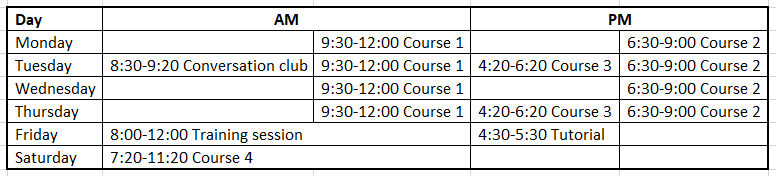
Since I started teaching, I’ve always written down lesson plans and notes. I keep everything on my PC, and I’m pretty sure that I could find at least some basic information about every lesson I’ve taught. It helps me track my progress as a teacher and see how my views have evolved. There is some other interesting stuff too. For example, when I was going through my work records, I found this schedule from the first half of 2019. Let’s take a look:
All work and no play makes a teacher's hair turn grey

That was probably my longest week as a teacher, and I guess you can imagine that I felt completely knackered at the end of it. To be fair, not all weeks looked like that because the training session took place only once a month. On the other hand, I was occasionally asked to administer exams or substitute for a colleague, which meant a few more hours spent at work.

What we are looking at here is a fairly common schedule that you can expect in an entry-level TEFL position in Colombia. Working for a private language institute is hard work; split shifts and six-day working weeks are the norm. If you sign a full-time contract with a company that sponsors your work visa, they will inevitably want to use your services as often as possible. Also, as I mentioned in the post about Colombian cities, Bogotá is infamous for even more demanding jobs that sometimes include commuting. Living close to the place of employment and not having to travel around the city is an advantage, but spending more than 30 hours per week at work eventually takes its toll.

Non-teachers will probably look at the schedule above with a sense of bemusement since a typical Colombian working week is 48 hours long. If you are a shop assistant in a run-of-the-mill clothes store, you can expect to spend six days a week at work and earn a modest salary that won’t allow you to rent a nice apartment on your own and pay all your living expenses. That’s why it’s so common to see adults living with their parents, which isn’t really surprising when you consider these circumstances.

I think that it’s very important to say that being a teacher involves more duties than the work you do in the classroom. You’ll spend a lot of time writing all kinds of reports and marking homework, tasks, quizzes, etc. You also have to plan your lessons, which is a crucial component of the job. When teachers are tired, they start cutting corners. Simply following the coursebook without personalising the content to your learners’ needs isn’t a good idea. Giving all your students random general recommendations instead of individual feedback won’t help you build rapport with the group. Don’t get fooled by ads that paint teaching jobs as a carefree experience; you have to be prepared to work hard. Teaching online doesn’t necessarily make things easier because you need to spend a lot of time making the activities user-friendly and appropriate for the tools you use.

The main consequence of working long hours is having less time for other activities. I decided to study for my Delta Module One exam while working those 30+ hours per week, and I experienced the most exhausting four months of my life. I had to find extra time for researching new topics in addition to my work schedule, which meant studying in the afternoon between the lessons and then doing most of my reading on Sundays. Fortunately, all that work paid off and I managed to pass the exam without any negative effects on my job, but it’s not something I would like to repeat.

I believe that having a life outside the classroom is extremely important. There are so many things to do in Colombia, so it would be a shame to spend most of the time here working. Being involved in something other than teaching is good for one’s well-being. That said, it’s important to have correct expectations because teaching English in Latin America isn’t a walk in the park. If you have no experience whatsoever, your first job probably won’t be great in terms of work-life balance. You may need to settle for a position that involves working long hours both inside and outside the classroom and getting a salary that is much lower than what you could get in some Asian countries.

The good news is that it gets a little easier with time. When you get some experience under your belt, your lesson planning will become more efficient. You can also recycle materials and activities, so it’s a good idea to store them in a way that makes them easy to find. With that in mind, I really don’t think that working long hours is something one should get used to. If you aim to deliver quality lessons to your students, you need to have time to prepare them. Having enough rest is crucial as well, because overworking has adverse effects on your private and social life.

What is important to emphasise is that you don’t need to stay in an entry-level position forever. Once you complete one or two years in that kind of job, you will become a more interesting option for other employers. Obviously, they are more likely to hire someone who is settled in the country rather than an inexperienced teacher who has just arrived. Speaking the local language and getting involved in professional development are things that will help you as well. I think there’s nothing wrong with getting in touch with other employers to see if they could offer you better terms.

Fortunately, I managed to escape the confines of a work visa, and my stay in Colombia doesn’t depend on an employer anymore. Switching to being an hourly-paid teacher isn’t great in terms of job security, but there is a lot more flexibility because I can decide how many hours per week I’m going to work. My usual schedule in recent months has been much more pleasant to look at:

All work and no play? No, thanks

I still work six days a week, but it’s more manageable now. While I was doing my Delta Module Two, I decided to reduce my teaching hours, which helped me pass the course. I sometimes accept extra work in the afternoon when I feel that I have enough energy for it. Having more free time is great because I have time to update this blog and do other stuff that helps me develop professionally.

Of course, it’s also necessary to completely disconnect from teaching from time to time. If I feel like reading a book or watching a movie, I can do so without a nagging feeling at the back of my mind. I absolutely love teaching English, but I don’t think this job should make me feel the way it did in 2019. Taking care of your physical and mental health is extremely important, so there have to be opportunities to take a break from all the teaching, planning, and doing administrative tasks. I’m much happier with my current schedule; I don’t need to rush anything, and I believe that this has a positive effect on the quality of my lessons.

► If you enjoyed this blog post, I recommend that you read More Than a Gap Year Adventure, a collaborative book aimed at those who wish to have a long-term career in our profession.

Review: Learn English with Ricky Gervais

Ricky Gervais and Karl Pilkington are known mainly for their acting work. What many people don’t know is that these two gentlemen are also accomplished English teachers. This blog post highlights the methods, approaches, and assumptions about language learning used in their showcase lesson. I recommend that you watch the following video before reading my analysis.

At the beginning of the lesson, Gervais sets out his methodological stall:

Learn English with Ricky Gervais

It is clear that he is a proponent of the direct method, which is based on using only the target language so that the students learn how to think in it (Larsen-Freeman 2000). This method became popular as a result of ‘the increased numbers of monolingual native speakers who started, in the twentieth century, to travel the world teaching English’ (Harmer 2007:64). Its opponents say that the direct method is just an excuse for not bothering to learn the language of the country where you work, but Gervais has pretty good reasons for choosing it. He is aware of the fact that his lesson is aimed at a multilingual audience, so he simply has to rely on English.

Gervais then introduces his co-teacher and highlights one of his prominent physical features. Pilkington disagrees with that approach:

Karl Pilkington in Learn English with Ricky Gervais

He is undoubtedly referring to the work of Michal Lewis. Pilkington is familiar with the lexical approach and the idea that ‘a principal role for the syllabus is to provide principled ways of including only maximally useful items’ (Lewis 1993:106). He correctly suggests teaching the learners how to ask for bread or milk.

Pilkington then gets distracted by thinking about the smell of milk and starts providing convoluted examples without paying attention to grammatical accuracy. Gervais needs to intervene:

Learn English with Ricky Gervais

This is something that needs to be emphasised. When we provide models of language that are too simplified, we run the risk of alienating the students. As Thornbury (2013:16) says, ‘it’s not just a question of making mistakes, it’s the ‘infantilization’ associated with speaking in a second language – the sense that one’s identity is threatened because of an inability to manage and finetune one’s communicative intentions’. Gervais’s solution is simple: Always speak proper English!

Pilkington responds by speaking proper English:

Karl Pilkington in Learn English with Ricky Gervais

Those of you familiar with the Delta Module One exam (Paper 2, Task 2) know that material creators work with assumptions about language learning. Pilkington believes that it is valuable for learners to be exposed to idiomatic expressions, and that’s why he uses go up to instead of approach. He also skilfully explains how the word smell can be both positive and negative. Well done!

What is really impressive about the lesson is how it deals with emergent language:

Learn English with Ricky Gervais

The main idea behind this is to ‘show learners that you value their output’ (Meddings & Thornbury 2009:20). Gervais is great at spotting the right moment for focusing on linguistic items that have emerged during the course of the conversation. Of course, the Dogme approach isn’t for inexperienced teachers, and you need someone confident in their abilities. Pilkington is one of those people, so he is always happy to provide concise explanations. When someone thumps you is a great example of that.

Both teachers then act out a few real-life scenarios:

Learn English with Ricky Gervais

Gervais and Pilkington don’t believe in pre-teaching lexis. They prefer Nation’s (2013:348) premise that ‘incidental learning from context is the most important of all the sources of vocabulary learning’. They empower the learners to work out the meaning of the words from context. I have to say that Gervais and Pilkington are masters of using schemata, which are ‘a means of representing that background knowledge which we all use, when we produce and interpret discourse’ (Brown & Yule 1983:250).

The authors also recognise the importance of explicit teaching:

Karl Pilkington in Learn English with Ricky Gervais

Pilkington uses /weə/ to highlight an issue that many English learners struggle with. Homophones certainly make the learning process complicated. Fortunately, his extraordinarily good examples I’m wearing a jumper and Where’ve you been? make the distinction between the two meanings perfectly clear. Great stuff!

As we know, it is very important to conduct a needs analysis at the beginning of the course. Let’s take a look at this crucial stage of the lesson:

Learn English with Ricky Gervais

According to Long (2015:88), ‘millions of adult learners around the world pay with their own time and money to acquire the very different functional language abilities they need, often urgently, to achieve their equally different educational or career goals or to meet immediate social survival needs in a new country, whether as tourists or newly arrived immigrants’. Gervais and Pilkington show how a pedagogic task (a role play in a safe environment) can prepare learners for satisfying their needs (such as an urgent cosmetic procedure) in the real world. They also realistically point out that not all people involved in customer service are pleasant and helpful.

At the end of the lesson, Gervais reminds the learners of the main lesson goal:

Learn English with Ricky Gervais

Did they manage to achieve it? I believe they did. The lesson provides students with everything they need when visiting England. Co-teaching is never easy, but in this case both teachers complement each other and put their expertise to a good use. I believe that the lesson is a great example of principled eclecticism. Gervais and Pilkington do what Larsen-Freeman (2000:183) calls ‘creating their own method by blending aspects of others in a principled manner’. The research process must have been very long and thorough, which helped the authors reach the pinnacle of their teaching careers. I don’t think it’s possible to create a better lesson, so it is no wonder that both protagonists decided to retire from ELT after publishing this valuable material.

References:
• Brown, G., & Yule, G. (1983). Discourse Analysis. Cambridge: Cambridge University Press.
• Harmer, J. (2007). The Practice of English Language Teaching. Harlow: Pearson Education Limited.
• Larsen-Freeman, D. (2000). Techniques and Principles in Language Teaching. Oxford: Oxford University Press.
• Lewis, M. (1993). The Lexical Approach. Hove: Language Teaching Publications.
• Long, M. (2015). Second Language Acquisition and Task-Based Language Teaching. Chichester: Wiley-Blackwell.
• Meddings, L., & Thornbury, S. (2009). Teaching Unplugged: Dogme in English Language Teaching. Peaslake: Delta Publishing.
• Nation, I. S. P. (2013). Learning Vocabulary in Another Language. Cambridge: Cambridge University Press.
• Thornbury, S. (2013). Big Questions in ELT. The Round.

► If you enjoyed this blog post, I recommend that you read More Than a Gap Year Adventure, a collaborative book aimed at those who wish to have a long-term career in our profession.