The importance of going beyond CELTA

It has been four years since I passed my CELTA course, which proved to be a life-changing experience because it allowed me to start working in a new field and move to another continent. It also gave me an opportunity to be trained by knowledgeable tutors who provided me with useful advice. I highly recommend this course to aspiring teachers.

That said, it’s important to note that CELTA is a foundation-level qualification with very low minimum entry requirements. It is often compared to a four-week boot camp that provides you with basic survival techniques. This blog post focuses on the course’s shortcomings in order to demonstrate why it’s necessary to keep improving as a teacher after obtaining the certificate.
Tips for getting a CELTA Pass A

It doesn’t address the use of L1 in the classroom
My teaching practice group on the CELTA course comprised students from four different countries, so there was no other choice but to use only English in the classroom. Even if your group is monolingual and you speak the students’ language, CELTA promotes the idea of teaching English through English. Of course, this is something practical because your lessons are observed and you can’t require tutors and assessors to be able to speak all kinds of languages. Being able to teach English without referring to L1 is undoubtedly a very useful skill to have, but if you land a job in a country like Colombia, using the learners’ mother tongue in the classroom can be really helpful.

It doesn’t prepare you for teaching young learners
The A in CELTA used to stand for adults. The certificate’s official name now refers to speakers of other languages instead, but it still didn’t provide me with any kind of training for teaching young students. When I was assigned my first course with ten-year-olds, I was completely out of my depth because you simply can’t treat children as adults. You can eventually figure out how to deal with teenagers, but teaching children while equipped with just a CELTA can be a very challenging experience.

It doesn’t pay much attention to phonology
To be fair, we did have two input sessions on teaching pronunciation. The problem is that this area is so complex that you need to spend much more time on it. The sessions were mainly about having fun with the phonemic chart, which was quite confusing and I had no idea how to use it in the classroom. The observed CELTA lessons didn’t need to include any in-depth pronunciation teaching; simple drilling activities were considered to be sufficient. If you wish to help your learners improve their pronunciation, you need to understand how individual phonemes are produced and why being aware of the main features of connected speech is crucial for understanding spoken English. It all started to make more sense to me a year and a half after my CELTA when I read Adrian Underhill’s book Sound Foundations.

It promotes a flawed approach to teaching skills
If you decide to take a Delta Module Two course, you will most likely be told by your tutors that you need to move on from what you were taught during your CELTA about teaching skills. This is particularly emphasised when it comes to receptive work because the comprehension approach with the usual pre-, while-, and post- stages is based on testing what the students already know, and that’s not good enough. You can actually do much for your learners by teaching relevant sub-skills and processes that can help them understand texts. I found John Field’s book Listening in the Language Classroom extremely helpful in this regard.

It doesn’t deal with SLA
CELTA is a very practical qualification, which is great because you learn a lot of useful techniques. However, it is quite prescriptive and you are just supposed to do what your tutors tell you. There is no time for reflection on why you are teaching in that particular way. If you are a curious person, you’ll probably want to know how people learn foreign languages. Being aware of the main SLA theories can influence your decisions in the classroom. Again, reading about this area takes a lot of time, so this is not something that can happen overnight.

It can lead to complacency
Obtaining a CELTA is very helpful in terms of career prospects. Even if you have an unrelated degree, you can take this short course and you will find it relatively easy to land an entry-level TEFL position in quite a lot of countries. Losing your job isn’t the end of the world because you are likely to find a new one somewhere else with this certificate. This safety net can have some negative effects, though. The last thing you should do after getting your CELTA is become overconfident, think you’ve made it as a teacher, and rest on your laurels for the rest of your career.

The point of this post is to emphasise that CELTA will show you only the tip of the iceberg, and there is much more to learn about ELT. Taking this course is definitely a good decision, but I think that it should be seen as a starting point in one’s professional development rather than something that will transform you into an amazing teacher. I believe that it’s important to build on the knowledge gained during the CELTA course and be open to learning new ideas about teaching English.

I understand that the idea of professional development may seem overwhelming to newly-certified teachers. There are so many books, articles, blogs, and other resources, and you may not know where to start. In that case I recommend reading the recently published ebook 100+ Professional Development Tips for Post-CELTA Teachers written by Pete Clements, which is a very useful resource for those who have just gotten their CELTA or CertTESOL. You can read my review of the book here.

► If you enjoyed this blog post, I recommend that you read More Than a Gap Year Adventure, a collaborative book aimed at those who wish to have a long-term career in our profession.

Review: English, please!

In the blog post about my work as a volunteer teacher, I referred to Daniel Le Gal’s article English Language Teaching in Colombia: A Necessary Paradigm Shift. What immediately caught my attention was that the author mentioned coursebooks designed specifically for Colombian students. One of them is English, please!, which was created by the Ministry of National Education in collaboration with the British Council and Richmond ELT. Its latest edition can be downloaded for free from this page, so I think that we should take a closer look at it.

Review: English, please

The series comprises three coursebooks aimed at students in the 9th, 10th, and 11th grade who have been studying English without making any progress. I work in the private sector and my students often complain about the level of English instruction in public schools. Adriana González wrote about this topic in English and English teaching in Colombia: Tensions and possibilities in the expanding circle, which I recommend reading in case you are interested in teaching English in Colombia. It would be harsh to blame teachers for the situation because it seems to be a systemic issue. English, please! is part of the government’s strategy to address that.

What you will notice right away is the fact that the coursebooks use British English. That is to be expected when the British Council is involved, but is that the right option for the students? In 2019, Colombia was visited by 4.5 million foreigners, and 22% of them were from the USA. Visitors from the UK didn’t even make the top 10, so they don’t appear in the government’s report. The country is geographically and culturally much closer to the USA, yet English, please! teaches Colombian students to use at weekends and a torch instead of the equivalents that are more common in the US variety of English.

In fact, in spite of writing my blog posts in British English, I actually use the US spelling and talk about soccer when I teach Colombian students because they are more familiar with it. I also point out differences between the two varieties of English when necessary. English, please! simply promotes the British one even though I think most Colombian teenagers would probably find learning American English more relevant to their needs and interests.

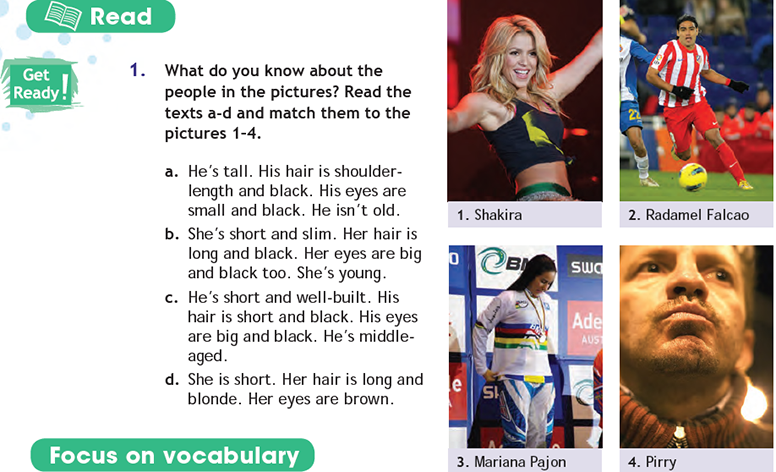
Fortunately, the coursebooks avoid the pitfalls of including content about random British celebrities. English, please! gives the students an opportunity to learn English while reading about Colombian food, places, people, etc. There is some international content referring to other parts of the world, but in general I can imagine the coursebook making the learning experience more personalised and engaging. It doesn’t always work perfectly well, though. Let’s take a look at the following example:

Review: English, please

The coursebooks were written by a team of Colombian ELT professionals and international freelancers. I guess the person responsible for this part isn’t a football fan. Falcao is a good player, but I certainly wouldn’t call him tall because in every game there are several teammates and opponents towering above him. In addition, the photo of the other guy isn’t great and you can’t properly see what colour his hair is. I think that they should have chosen something better than an image downloaded from Wikipedia.

To be honest, I think the first book, which is supposed to be used with 9th graders, is the weakest one from the series. I think some parts could have been done in a slightly different way. For example, this is how students whose English is at a low level are encouraged to improve their listening skills in the first lesson:

Review: English, please

English, please! contains glossaries with words and lexical chunks translated into Spanish. I suppose this is based on the fact that the books are expected to be used in a monolingual environment, so it’s not a completely bad idea. I’d still prefer to use dictionaries because I find them more helpful than word-for-word translation. There is also some strange stuff in the first coursebook. I wouldn’t call myself an expert in the Spanish language, but this explanation of special cause doesn’t seem right:

Review: English, please

The good news is that the following two books are considerably better. There are a lot of opportunities for collaborative work, and I imagine that students will enjoy doing some of the tasks. The texts about Colombia aren’t bad either. It was also quite interesting to see that the writers decided not to avoid PARSNIP topics. The following activity is from the last book, which is meant to be used with students older than 16:

Review: English, please

There are no surprises when it comes to the linguistic content because English, please! follows the traditional synthetic syllabus. It contains the same ‘building blocks’ of language that you will find if you pick up any run-of-the-mill coursebook, and I think that it’s necessary to supplement it with other activities and materials. Its main advantage is that it deals with topics that Colombian students are familiar with, so the teacher doesn’t need to spend a lot of time on personalising the coursebook content.

I’d say that English, please! is a nice attempt to come up with something more appropriate for the local market. It isn’t perfect, but using this series makes more sense than teaching completely random topics from a book designed without any specific target audience in mind. I just don’t think that coursebooks are the main issue in ELT in Colombia. Teachers who have received relevant training will deliver amazing lessons even when they are asked to use a terrible coursebook because they will adapt the activities or abandon most of the book and design their own materials. Of course, if local teachers’ training consists mainly of being taught about language, then even the best coursebook in the world won’t be very useful.

This series also contains something I haven’t seen in any other publication of this type. If you open this PDF file and go to page 2, you will encounter an interesting name there. I mean, his English is great, but I wonder why this man is listed on the credits page of a coursebook for high school students. Any ideas?

► If you enjoyed this blog post, I recommend that you read More Than a Gap Year Adventure, a collaborative book aimed at those who wish to have a long-term career in our profession.