More Than a Gap Year Adventure

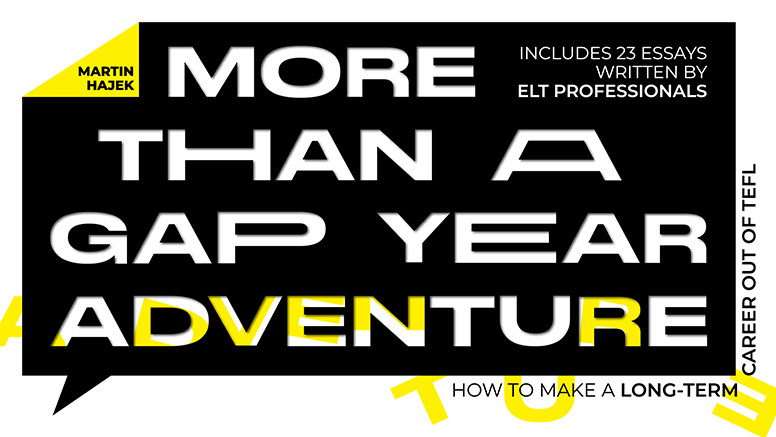
I’ve been writing this blog for a few years, so I decided it was time to get involved in creating something a bit more serious, namely an ELT book. I’m happy to announce More Than a Gap Year Adventure: How to Make a Long-Term Career out of TEFL is now available for purchase on various online platforms. I created the book together with a group of amazing ELT professionals whose contributions make it a very valuable read.
More Than a Gap Year Adventure: How to Make a Long-Term Career out of TEFL

What is the book about?
This is the book description used on Amazon and other online stores:

Teaching English is often perceived as a temporary job abroad, yet it is perfectly possible to have a long-term career in the profession. More Than a Gap Year Adventure provides teachers with information they may not have access to at the beginning of their career, which can help them avoid common issues that in many cases result in English teachers leaving the field disillusioned. In addition to actionable advice for moving beyond entry-level TEFL roles, the book includes 23 essays written by experienced professionals providing real-life tips based on the writers’ personal experience. More Than a Gap Year Adventure promotes the idea of being proactive in career development so that one can find a rewarding ELT job with a reputable institution or create their own business.

Where can I get it?
PDF: Payhip, Gumroad
ebook: Amazon, Apple Books
paperback: Amazon

Who is it for?
Anybody who is interested in career development in ELT will find something useful in the book. Those thinking of getting into TEFL will receive ideas for getting started; developing teachers who would like to make career progress will get advice on that as well. The book answers a lot of questions that are frequently asked in online groups, and I describe it as a resource that I wish I had read when I decided to become an English teacher.

Why should I read it?
The book mentions some uncomfortable truths about our profession and provides specific recommendations on dealing with common challenges that teachers may face. And most importantly, there is a wealth of knowledge (and links to other useful resources) in the essays written by the following ELT professionals:

Fatime Losonci, Tiago Bueno, Kate Lloyd & Kris Kirby, Jim Fuller, Sandy Millin, Michelle Adele Wardman, Ariella Moses, Andrew Woodbury, Rachel Tsateri, Joanna Hebel, Peter Clements, Martin Sketchley, Laura Wilkes, André Hedlund, Kate Khurtsilava, Sebastiano Favretto, Zorica Kovacevic, Silvina Mascitti, Noreen Lam, Monica Ruda, Walton Burns, Hall Houston, Mohamed Oummih.

What specific topics does it deal with?
You can download the Contents page of the ebook version here.

How long is the book?
There are 78,472 words (206 pages) in the PDF document. The paperback version is 299 pages long.

Book mentions and reviews
Monica Ruda’s sneak peek
Mohamed Oummih’s article
Rachel Tsateri’s blog post
Christopher Walker’s review in the IH Journal and on Goodreads
Jim Fuller’s review
Joanna Hebel’s blog post
Martin Sketchley’s article
Paola Dell’ Acqua’s review in the TESOL Spain newsletter
Christopher Miller’s review in The English Connection

Interviews
My chat with Teresa Bestwick from the TEFL Development Hub
Episode 138 of Ola Kowalska’s podcast Get Richer, Teacher!
TESOL Pop S10E05: Start Building the Career You Want

What will happen if the book makes a lot of money?
I would like to reward the brilliant professionals who made this project possible, so the proceeds will be shared with everybody involved in creating this book.

What should I do if I like the book?
Please recommend it to someone you think may enjoy reading it. Leaving an honest review on the website where you purchased it will be appreciated as well.

Review: All of the Above

Dorothy Zemach is an ELT professional with extensive experience in a variety of areas. Many teachers have used her materials in the classroom; I did so in the first two years of teaching English in Colombia. She is the go-to person if you want to learn about self-publishing. If you are interested in that, keep an eye on the iTDi website for one of her future courses. When she advertised her latest book All of the Above: Essays on Teaching English as a Foreign Language on social media, I knew that it would be worth reading.

Dorothy Zemach: All of the Above

My first impression was that All of the Above would be similar to Scott Thornbury’s Big Questions in ELT, which is another title I recommend to teachers, since both books are collections of unrelated shorter texts. There are some key differences, though. While Thornbury refers to other resources in his book, Zemach’s essays are much more personal and the content is based on her own experience. I’m happy to say that I think it works very well and makes for an enjoyable read.

All of the Above comprises sixteen essays and three additional chapters dedicated to games, so there are a lot of takeaway points one can get from the book. I’d like to use this blog post to comment on a few ideas that made me think about my work as a teacher.

What I really like about the book is that Zemach refers to various teaching contexts in which she has worked. She points out that some teaching approaches may not work equally well in all environments. Having fun in the classroom without any tangible results isn’t ideal, and some students may actually learn useful language through drilling activities. That reminded me of Lightbown and Spada’s book How Languages are Learned, which mentions that gifted students are capable of reaching a high level of English even when their teachers use what many of us would call outdated methods. I’d say this is a good moment to promote the idea of doing meaningful activities in the classroom and providing the learners with feedback on the language (the focus on form approach).

The book also takes a look at tools that can help people improve their written texts. I agree with the author who says that students should spellcheck their documents before submitting them. I do so myself when I write blog posts or send important emails, so I advise my students to use that as well. Zemach then shows screenshots depicting some ridiculous corrections suggested by a grammar checker to warn against using that tool. I think that depends on the kind of software one uses because the spelling and grammar checker utilised by Google Docs is genuinely good. It’s not perfect and I wouldn’t rely on it at all times, but I find it helpful in my online classes. It can give the students immediate suggestions related to grammar, which can provide some good opportunities for learning.

When I read ELT literature, I’m very happy when I encounter practical tips that I can use in my professional life. I have some experience with changing jobs and attending interviews, but All of the Above provided me with an important recommendation I hadn’t thought of before. The author suggests that teachers ask about the institution’s policy on absences during the job interview. That immediately brought back a memory of a situation that took place right after I’d started working at a language institute a few years ago. A colleague of mine asked me to sub for him due to having a doctor’s appointment, and I agreed. Unfortunately, the teacher was then told off by the director for making unauthorised arrangements and the substitution request was declined because of a difference between our hourly rates. My attempt to help my colleague out inadvertently created a bit of an issue, and I wished I had asked about the policy beforehand.

My favourite essay in the book is called My dear. The author says that there are benefits to using social media for professional purposes, but it also causes some issues that should be talked about. This passage of the essay describes a rather curious phenomenon:

Clearly, that is not how everyone uses Facebook, or I wouldn’t get so many strangers sending me the “Hi” messages. Often, in fact, that is the entire message—“Hi.” From someone I don’t recognize. I have no idea what sort of response they are expecting. Do they want me to stop in the middle of my work day and respond with “Hi” as well? Do we then move on to “How are you?” and “Fine, thanks, and you”? But why? Why would we (two virtual strangers, with nothing more in common than that we both teach English) do that?

To put it simply, some people don’t come across well on social media, and that includes English teachers too. I’m aware of cultural differences, but I expect people to have at least some basic sense of decency when communicating online. Some private messages and public posts make me wonder how that individual talks to their students and whether teaching is the right profession for them. I don’t mind being perceived as rude when I don’t want to waste time on conversations that I’m 100% sure won’t get anywhere. Apart from the ‘Hi’ people, I tend to get ‘friends’, who you can read about on the ELT Planning blog, and other interesting characters. I’ve even had to block a few users when I didn’t feel comfortable with the discussion at all.

Zemach highlights the fact that invasive chats are initiated mainly by men. That is related to another huge issue because there seems to be a fine line between being an awkward stranger and something much worse. It’s not a secret that women often receive inappropriate messages on social media, even on supposedly professional platforms such as LinkedIn. I have no idea why someone would think that online harassment is a good idea, but there are people like that out there.

The author suggests that the culture of chat messages should receive more attention in ELT materials. It certainly makes sense to use authentic or made up chats in the classroom and analyse them. In addition, I often communicate with my learners through WhatsApp, and when I get a message that could make a bad impression on someone, I address it in the subsequent lesson and provide the student with some examples of more appropriate language that could be used instead.

There are plenty of other thought-provoking ideas in the book, and I think everybody interested in ELT will probably find something useful in it. The book is also well-written and easy to read, which is exactly what you would expect from a title written by an experienced author and editor. If you enjoy reading TEFL-related essays, Dorothy Zemach’s All of the Above will make a really nice addition to your digital or physical library.

► If you enjoyed this blog post, I recommend that you read More Than a Gap Year Adventure, a collaborative book aimed at those who wish to have a long-term career in our profession.