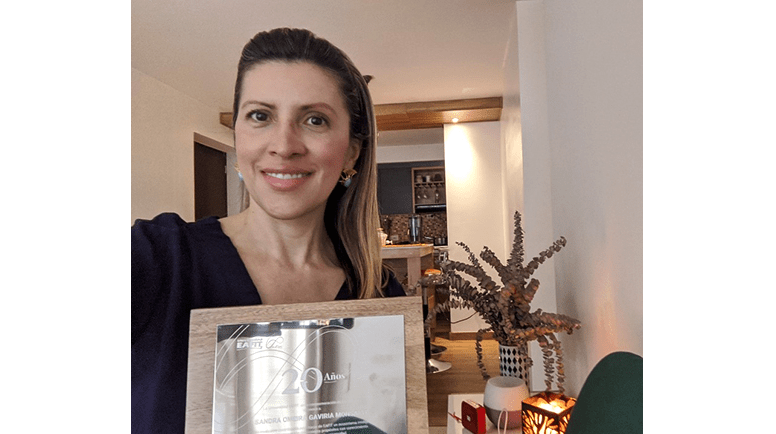
Today’s interviewee is an experienced teacher and coordinator based in Medellín. We discussed the future of online teaching, approaches to assessment, native speakerism in Colombia, the importance of teaching writing skills, and other topics related to ELT.
Sandra Gaviria has been working for Universidad EAFIT in Medellín since 1992. She started teaching English after obtaining her BA in Modern Languages at Universidad Pontificia Bolivariana and MA in TESOL at West Virginia University. Sandra was promoted to her current role of academic coordinator in 2000. She is involved in curriculum development, test design, teacher training, and other activities in the academic area. Sandra also holds a Bachelor’s degree in Journalism and a Master’s in Educational Innovation.
Let’s start with the beginning of your teaching career. What was your main motivation to become an English teacher?
It was kind of an accident. I was fascinated by English speakers, but there weren’t many opportunities to talk to foreigners here in Medellín at that time. I love languages, so I decided to study English and French because I knew that I would enjoy it. I initially focused only on learning the languages and the idea of teaching didn’t really hit me until I did my practicum. That experience helped me find out that I was born to be a teacher, and I have been involved in ELT since then.
You did your master’s degree in the USA. How did that come about?
When I was in the third year of university, a Colombian professor brought a group of foreigners to a summer course at Universidad Pontificia Bolivariana. They needed a host family for one of the participants, so I volunteered and spent a month with a Japanese student at my parents’ place. The professor then told me to contact him after graduation regarding an opportunity to become a teaching assistant in the US. I worked for a year and a half in Medellín to save money because I had to pay for all of my expenses. Fortunately, everything went smoothly and I was able to do the degree at West Virginia University.
After returning to Colombia, you started teaching at Idiomas EAFIT, which had opened only a year before. What was your experience like and how has teaching English changed since the 1990s?
It was a new programme, so it wasn’t as structured as it is now. I remember that when I became a teacher, we didn’t have any assessment rubrics and I had to design my own tests. The curriculum was provided by the textbook, but the teachers were practically on their own. I spent eight years working as a teacher before my current position opened up. Our programme needed something more official, so I decided to standardise things after becoming a coordinator. It was very challenging at the beginning, but it was absolutely necessary.
By the way, the city of Medellín is often praised for its transformation in the last few decades. What is the most significant change that you have experienced?
As a child, I would go many years without seeing a foreigner. That changed completely, and before the pandemic we would get many students from abroad learning Spanish or participating in exchange programmes at our university. Seeing people from abroad on campus and in Poblado was very common. They became part of the landscape, and I hope we will soon see foreign students return to Medellín.
I see that you have written a lot of blog posts and other articles on a variety of topics, and you have a degree in journalism. Do you think there are any transferable skills between journalism and teaching?
I think that these areas are connected because every English language teacher should know how to write. I mean, it’s not necessary to be able to write literary pieces, but a teacher’s writing skills have to be at a good level. Writing is one of the most neglected skills when it comes to teaching English. Having students write is not just about giving them the topic, but it requires structure as well. It’s also about the flow of ideas, organising paragraphs, etc. Every language has its own rules, so writing in Spanish isn’t exactly the same as in English, and being aware of that can help teachers guide their students.
You also worked as a master’s programme instructor at Universidad de Caldas. How would you describe your time in Manizales?
I enjoyed it very much. I learned a lot because I had to prepare completely new things, and that helped me with my day-to-day tasks. I’m still in touch with some of the people from the master’s programme; one of them is actually working with us at EAFIT. It was great from a professional point of view, but it was very exhausting. I had to travel a lot, so I didn’t have any break for a long time. Also, those small planes that fly to Manizales don’t provide the most comfortable experience.
What can you tell me about your MA in Educational Innovation from Maharishi University?
I was expecting that to be more technology-oriented, but it was a little different. What I really loved about that programme is that every single student needs to learn Transcendental Meditation (TM). We also ate healthy food and did in-class meditation together. It’s a small university, so we all felt very close to each other. They use a block system, which means that you concentrate only on one subject at a time. The institution created an ideal environment for students and I enjoyed every second of my year there.
Let’s talk about March 2020. Schools in Colombia were closed practically overnight, which must have been very tough for you as a coordinator. How did you deal with the sudden switch to online teaching at Idiomas EAFIT?
The most important part was that we worked as a team and made sure that all the teachers received sufficient training to start teaching online. We cancelled classes for an entire week to get ready for delivering lessons through Teams. It was very tough for me because I worked day and night and kept communicating with our teachers and students, so by the time we got to Semana Santa in the middle of April, I was exhausted and needed that one-week break. We got the hang of things a few weeks later, which allowed us to start experimenting with new applications. It’s been a very interesting process because it forced us to make quick progress in online education.
I know that you’re back to in-person teaching at EAFIT. How has it been?
Our classrooms were designed for small groups, so we can have only a limited number of students in them due to the current restrictions. I have to say that it’s great to see our students back on campus. The university also acquired amazing 360-degree cameras and high-quality microphones, which gives us the option to run hybrid courses as well. Of course, working with two groups of students at the same time isn’t easy, so this is another challenge we have to deal with. In addition to that, we continue offering fully-online courses.
Do you think that some students may prefer to attend online courses even when the pandemic is over?
I think so. My prediction is that the working professionals are going to be interested in continuing to study online. Commuting to our early morning and evening classes can be time-consuming, so I imagine that those courses will stay online. On the other hand, the undergraduate students at our university will most likely prefer to learn in the physical classrooms.
One of your many responsibilities is observing teachers and giving them feedback. Would you like to share some tips for teacher trainers who are involved in lesson observation?
I’ve learned throughout the years that the more you help to lower the teachers’ anxiety, the better. I usually announce the observation beforehand and I’m also open to negotiating the date of the observed lesson. The teachers generally give me a lesson plan, but I don’t require them to follow it to the letter. I believe that you need to be able to adapt your lesson based on the students’ needs. The teachers need to show that they can be flexible.
I often think of my role as an observer. My presence in the classroom influences what happens in the lesson because some students may think that I’m there to observe them. Sitting in the corner and taking notes may not always be the best option, so I prefer to write my thoughts down at the end of the lesson. I also think it’s a good idea to break the routine from time to time and do things differently to make the teacher feel more comfortable. Sometimes I enjoy the lessons so much that it’s hard for me not to participate!
In addition, my years of experience have taught me to be more understanding. I know that I’m looking at just one snapshot, so I can’t generalise and think that’s what happens every day in that particular teacher’s classroom. I believe that it’s very important to listen to the teacher during our post-observation meeting to find out what their perspective is. When we identify something that needs to be improved, the teacher needs to come up with a plan with concrete actions that should be implemented into their teaching practice. I think the teachers need to be involved in the process rather than just being told what to do.
You are also involved in testing and curriculum development. What are the biggest challenges in these areas?
Some Colombian institutions claim to adhere to the communicative approach, but their tests are very traditional. That type of assessment is decontextualised and doesn’t really integrate skills, so at EAFIT we decided to move away from it. We don’t give our students paper-based summative tests, but our assessment is more ongoing and involves a variety of activities. There is a project at the end of each unit, and we aim to make our students think beyond English and focus on ideas such as sustainable development, protecting the environment, and helping the community.
Have you had any experience with native speakerism? I think that Colombia is one of the countries where this issue is very common.
This is an issue especially when it comes to the corporate courses because those students often ask for native English speakers. It makes me upset because we are a team of qualified, hard-working professionals who studied hard to become language teachers. I find it really strange that some companies would rather hire someone with no training in language teaching at all. Sadly, sometimes it’s just a matter of having a gringo name. Some students don’t want to be taught by someone born and raised in the USA just because their name doesn’t sound foreign.
We can certainly see some situations that make no sense at all. Is there any way we can change people’s attitude?
Like any other idea that’s embedded in the culture, it won’t change overnight. It would help if people who have hired foreigners with no training shared their experience and compared it to being taught by a qualified teacher. I hope the idea that training is more important than the teacher’s passport spreads through word of mouth. We try to lead by example, so our language centre has a well-defined hiring process and we are very cautious about hiring backpacker teachers who just need a visa. Our teachers are qualified professionals who are proficient in the language they teach, and they also receive relevant in-service training. I believe that emphasising the importance of teaching qualifications and training is the best way to approach this issue.
► If you enjoyed this interview, I recommend that you read More Than a Gap Year Adventure, a collaborative book aimed at those who wish to have a long-term career in our profession.
 TEFL in Colombia